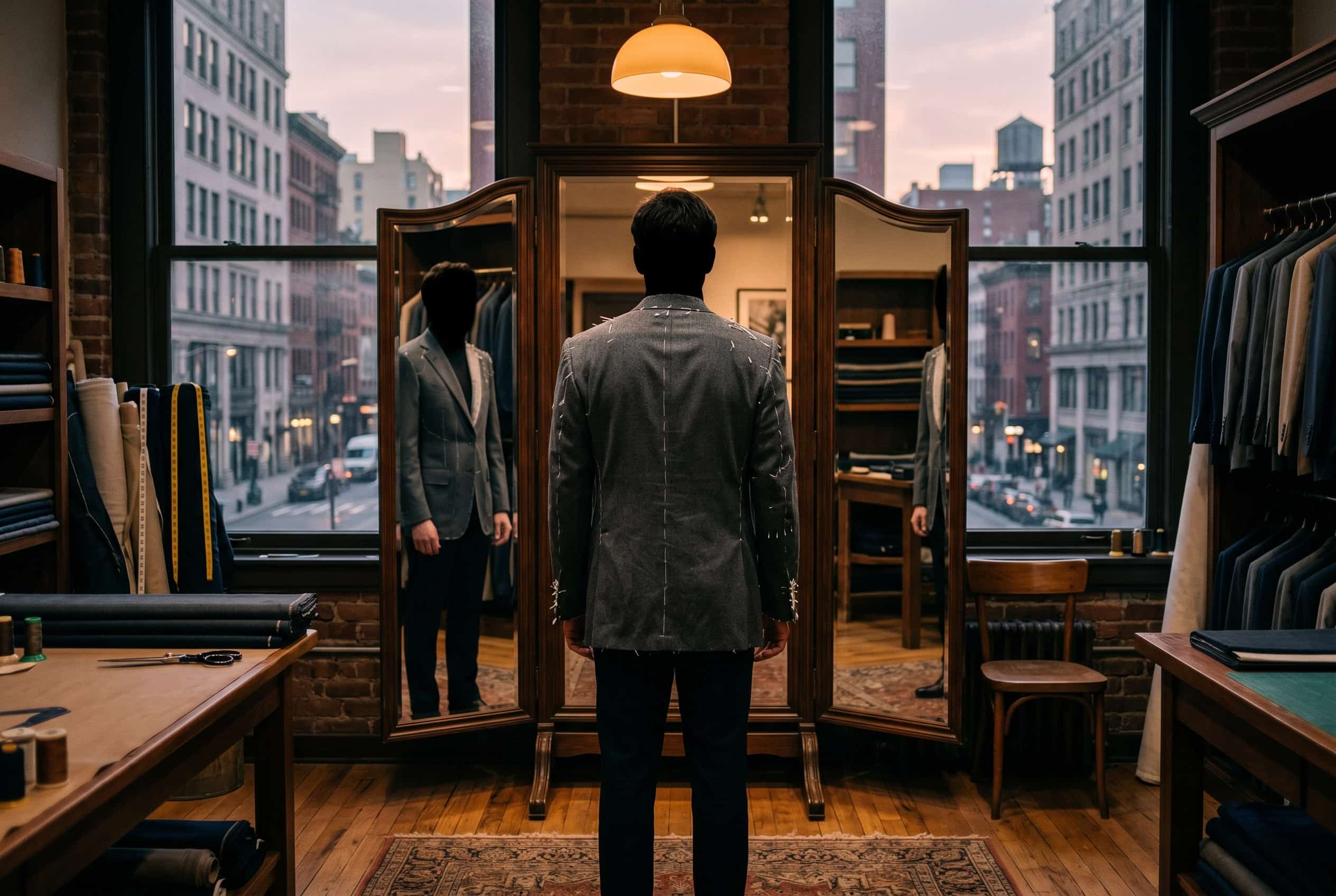
A man once walked into my consulting studio wearing a jacket from a label most people would recognise instantly. The fabric was good. The colour was right. And yet he looked uncomfortable, unpolished, as though he had borrowed the garment from a more successful version of himself. The problem was not the brand. It was the fit. The shoulders drooped. The sleeves swallowed his wrists. The trousers pooled around his ankles like an afterthought. That jacket cost more than most men’s monthly wardrobes, but the fit made it look like an airport purchase made in haste.
I pinned the shoulders. I marked the sleeves. I had a tailor adjust the trouser break. When he saw himself in the mirror again, his posture had changed. He stood taller. He spoke slower. The clothes had stopped fighting him and started working for him. That is the power of fit. It is the cheapest, fastest, most transformative upgrade a man can make, and it is the one most men ignore.

Why Fit Is the First Upgrade
Men chase labels, limited editions, and seasonal colours because the market tells them those things matter. The market is wrong. A perfectly cut jacket from a no-name brand will always outshine a sloppy designer piece. Fit is the architecture of presence. Without it, even the finest wool and the most prestigious monogram collapse into visual noise.
Fit communicates something deeper than taste. It signals that a man pays attention. That he understands his own body. That he respects himself enough to refuse clothing that does not serve him. A man in a well-fitted garment looks deliberate. A man in an ill-fitted garment, no matter how expensive, looks careless. The difference between those two impressions is measured not in currency, but in credibility.
The Three Non-Negotiable Fit Zones
Most fit mistakes cluster in three areas. Fix these, and the entire silhouette shifts from apologetic to authoritative. Ignore them, and no amount of styling will rescue the look.
Question: Which fit mistakes immediately cheapen a man’s outfit, and how should they be corrected?
Fit Zone | Common Mistake | Why It Looks Cheap | The Correct Approach |
|---|---|---|---|
Shoulder line | Jacket shoulders extending beyond the natural bone, or pulling too tight across the deltoid | Reads as borrowed or juvenile, disturbs the clean vertical frame | The shoulder seam should end exactly where the shoulder bone ends. No overhang, no tension lines. |
Sleeve length | Sleeve covering the entire shirt cuff, or riding up to expose too much wrist | Obscures the crisp line between jacket and hand, signals a rented garment | Allow a quarter-inch of shirt cuff to show. The jacket sleeve should break slightly at the wrist, not stack. |
Trouser rise and break | Low-rise trousers that cut the torso in half, or excessive fabric pooling at the shoe | Shortens the leg, widens the silhouette at the floor, looks unkempt | Mid-to-high rise to elongate the leg. A slight break or no break, depending on shoe formality, to keep the line clean. |
Fix these three zones, and the same wardrobe you already own will suddenly look sharper, more deliberate, and significantly more costly than it did the week before.
The Shoulder Line: Where Authority Begins
The shoulder is the first part of a jacket the eye registers. It sets the frame for the entire upper body. When the shoulder fits, the chest and back drape naturally. When it does not, every other proportion is distorted.
I have watched men try on jackets with shoulders half an inch too wide, convinced they could “grow into it” or that the extra room conveyed a broader frame. It does the opposite. Excess width at the shoulder creates a concave, softened outline that reads as undefined. Too tight, and the fabric pulls into horizontal stress lines, broadcasting discomfort. The correct shoulder seam sits cleanly at the edge of the deltoid, neither collapsing inward nor jutting outward. It creates a sharp right angle where the arm meets the torso, a visual anchor that signals composure.
Sleeve Length: The Reveal That Signals Precision
Sleeve length is the detail no one consciously notices, yet everyone unconsciously feels. When a man’s sleeve covers his entire hand, it looks as though he has not finished getting dressed. When it exposes too much arm, it suggests the garment has shrunk or was never his to begin with.
The rule is simple and absolute: a small band of shirt cuff should be visible when the arm rests at the side. This small flash of light fabric creates a visual break between the jacket and the skin, a punctuation mark that reads as considered. It is the kind of detail that separates a man who dresses himself from a man who simply wears clothes.
Trouser Rise and Break: Controlling the Vertical
Men underestimate what trousers do to the silhouette. Low-rise trousers cut the body at the widest point of the hips and make the torso appear short and blocky. A higher rise, sitting closer to the natural waist, restores proportion. It lengthens the leg line and draws the eye upward, creating a more commanding vertical presence.
The break — where the trouser hem meets the shoe — is the final judgment. A heavy break that crumples over the laces looks accidental. A clean, slight break or a sharp no-break finish, depending on the shoe style, keeps the line uninterrupted. That uninterrupted line is what makes a man look taller, leaner, and more composed from across a room.

What the Fitting Room Taught Me
I spent years watching men assess garments in front of department store mirrors. The ones who looked at the label first rarely walked out looking better. The ones who tilted their heads and checked the shoulder seam, who lifted an arm to gauge sleeve pitch, who stepped back and studied the trouser drape — those were the men who understood. They treated clothing as a structural problem, not a branding exercise.
One client stands out. He had a wedding to attend and nothing in his closet he felt confident in. We found a simple navy suit, well within a reasonable budget, and spent the alteration budget on shoulder adjustment, sleeve shortening, and trouser tapering. He sent me a photograph from the event. He was not the most expensively dressed man there. He was, by his own account and by the reactions he received, the one everyone assumed was the most successful. That is the return on a good fit. It pays out in perception long after the receipt is forgotten.
A Final Word
If your clothes never look expensive, do not buy more. Do not chase a different label. Walk into a tailor’s studio instead. Alter the shoulders so they frame you. Shorten the sleeves so they reveal just enough. Raise the trouser rise and control the break so your legs read as long and deliberate. This is not fashion advice. It is structural correction. And it is the only first step that matters.
Luxury is not the label. It is the discipline.