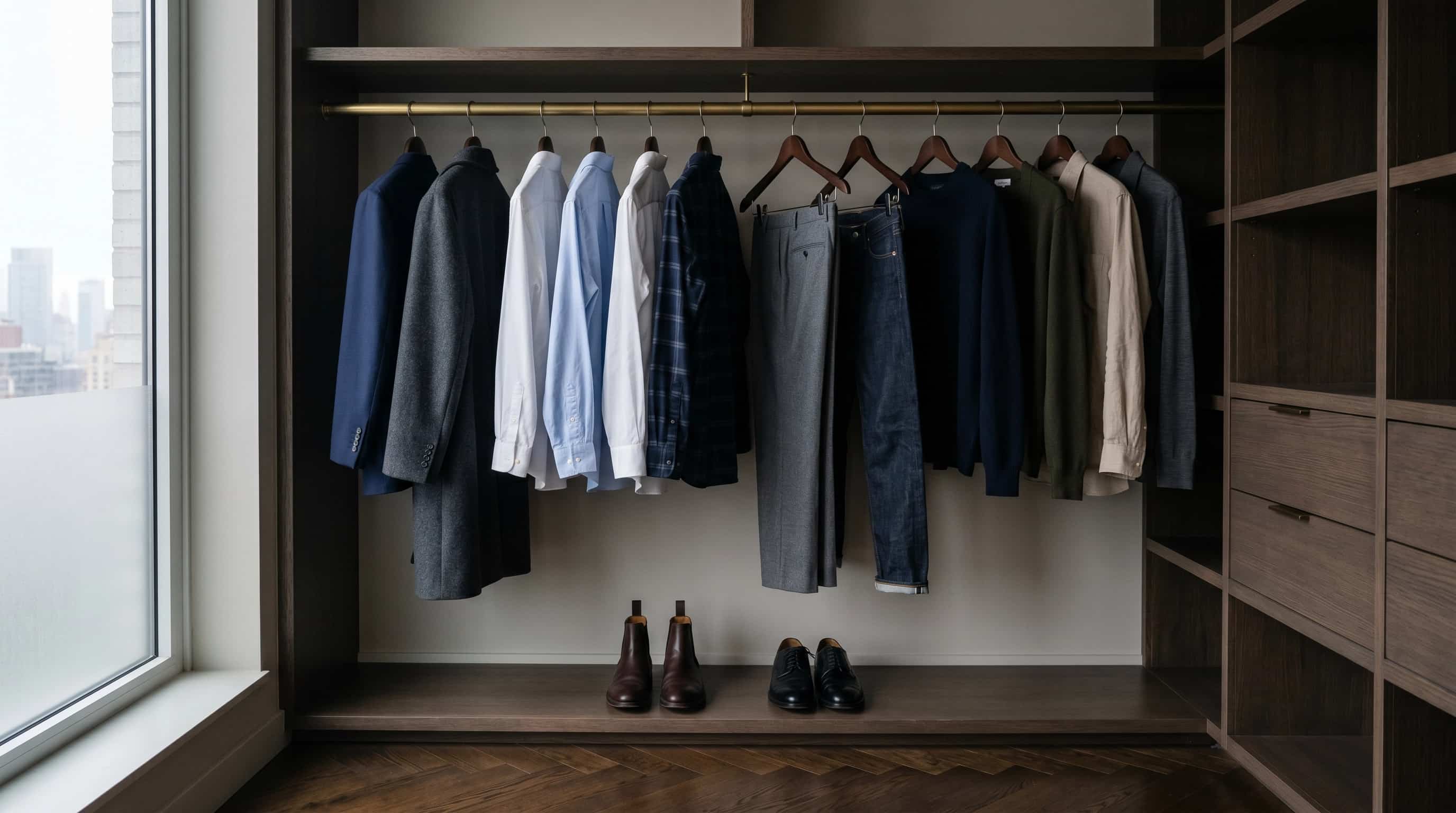
A man once asked me to build his smart-casual wardrobe from nothing. He expected a list of designer names and seasonal recommendations. Instead, I gave him twelve pieces. None carried a visible logo. Every single one could be worn with every other. The conversation became the foundation for this article, and the framework has since served every client who understood that a wardrobe is not a collection — it is a system.
Smart-casual is the most abused term in menswear. For most men, it means a blazer that does not fit, a shirt that has never seen an iron, and sneakers that cost more than a good pair of shoes. The result is neither smart nor casual. It is just confusion worn with confidence. A serious man’s version of smart-casual is built on structure, proportion, and pieces that refuse to shout. The goal is not to look dressed down. It is to look composed without looking corporate.
The Twelve-Piece Architecture
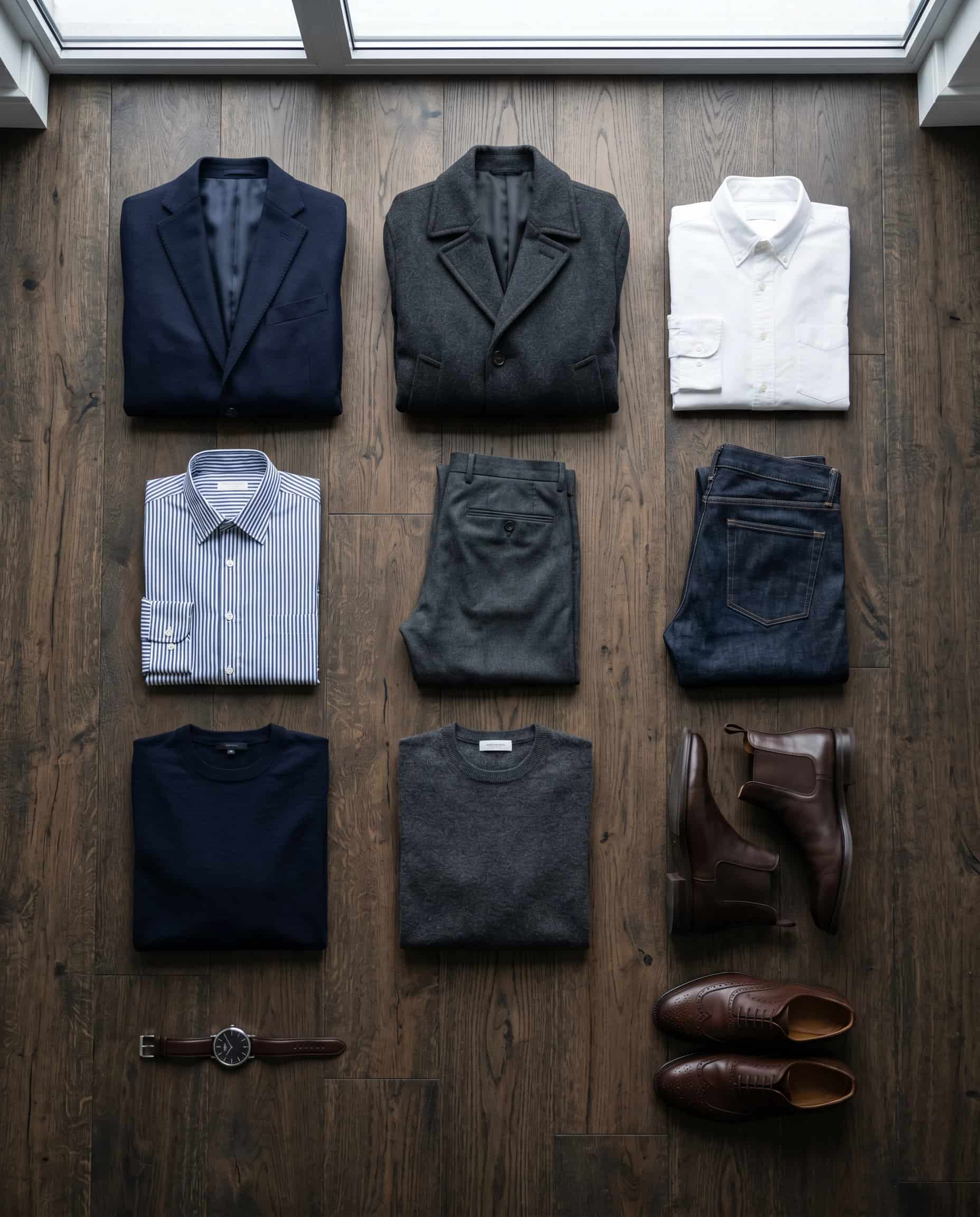
Before a single garment is purchased, a principle must be set: every piece must earn its place by working across at least three different contexts. If a jacket only works for one occasion, it is a liability. If a pair of trousers cannot transition from a business lunch to a weekend evening, it belongs in someone else’s closet.
The following table answers the question most men never ask before they start buying.
Question: What are the twelve pieces that build a serious man’s smart-casual wardrobe, and what role does each play?
Piece | Why It Matters | Investment Guidance |
|---|---|---|
Navy blazer, unstructured | The spine of smart-casual. Softens formality without losing authority. | Invest in fabric and shoulder fit. Brand is irrelevant. |
Charcoal wool overcoat | Top layer that defines a man’s silhouette before he enters a room. | One good coat lasts a decade. Choose weight and drape over trend. |
White oxford cloth button-down | The cleanest backdrop a man’s face can have. Works with everything. | Mid-range is fine. Fit is everything. Replace when the collar softens. |
Light blue spread-collar shirt | Slightly dressier alternative to white. Adds depth without decoration. | Same principle. Spend on cotton quality, not name. |
Grey wool trousers, mid-rise | The bridge between suit trousers and casual bottoms. Elongates the leg. | Worth spending for a proper drape and a clean break. |
Dark indigo selvedge denim, straight or slim-straight | The only denim that reads as intentional, not adolescent. | No distressing. No logos. Mid-range often outperforms premium labels. |
Fine-gauge merino crewneck, navy or charcoal | Replaces the hoodie and the sweatshirt. Quiet, sharp, layerable. | Do not overspend. This is a replenishable piece. |
Lightweight cashmere V-neck, camel or oatmeal | Adds warmth and texture without bulk. Signals taste under a blazer. | Worth a considered purchase. It will be worn often and noticed rarely. |
White leather minimalist sneakers | The only sneaker a grown man should wear with tailoring. | Clean, unbranded, full-grain leather. Replace when they look tired. |
Dark brown suede chukka boots | Grounds smart-casual looks with texture and maturity. | Reasonable investment. Suede care is more important than the price point. |
Black calfskin wholecut oxfords | When the occasion demands more than a boot but less than a suit. | Spend here. Cheap dress shoes announce themselves immediately. |
Thin manually wound dress watch, leather strap | The only accessory a man needs. Worn under a cuff, not over it. | One good watch. No complications. No visible branding on the strap. |
The Non-Negotiable Foundation
Of these twelve, four pieces do the heaviest lifting. The navy blazer, the white oxford shirt, the grey wool trousers, and the dark denim form a neutral chassis onto which everything else can be bolted. If a man owns nothing else, these four will carry him through more professional and social situations than a closet full of impulse purchases.
The blazer must be unstructured. Structured shoulders pull the outfit back into suit territory. Unstructured shoulders relax the silhouette without collapsing it. The white shirt must be pressed, the collar must hold its shape, and the cuffs must show a precise quarter-inch below the jacket sleeve. The grey trousers must sit at the natural waist and break cleanly across the top of the shoe. The denim must be dark, unadorned, and cut to follow the leg without gripping it.
These four pieces cost less than most men spend on a season of mistakes. They last longer than any trend. And they will never, under any lighting, look like you tried too hard.
Where Restraint Pays Off
Outerwear and footwear are where a man’s silhouette is made or broken from a distance. The charcoal overcoat is the first thing anyone sees when you arrive. If it fits across the shoulders and falls without pulling, it frames the entire body before a single interior garment is visible. Spend time on this. The wholecut oxfords are the final visual punctuation. In a room full of square-toed shoes and tired loafers, a clean black wholecut reads as precise, deliberate, and quietly formidable.
The watch is an accessory but functions as a signal. A thin manually wound dress watch on a leather strap tells a story of self-containment. It does not need to be recognised from across a table. It only needs to be correct when it is glimpsed.
The Pieces You Can Hold Back On
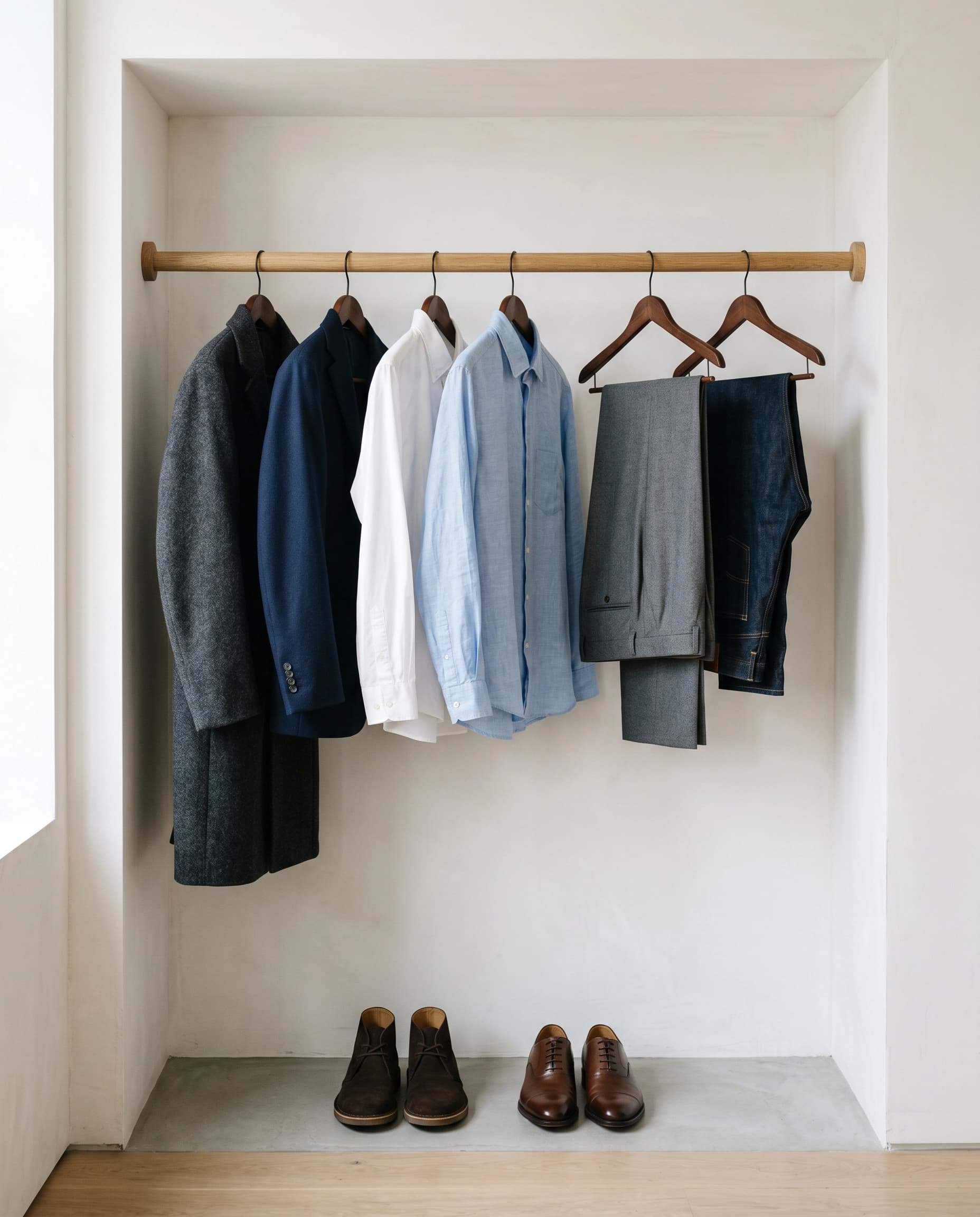
Several items on the list are replenishable. The merino crewneck and the white leather sneakers will wear out with regular use. They should be replaced with identical or near-identical versions when they do. There is no advantage to paying a premium for a logo that will be invisible to anyone who matters. The denim, similarly, should be sourced from makers who specialise in denim, not from fashion houses who treat it as a side product. The cashmere V-neck is worth a thoughtful purchase, but it does not require a name that announces itself. The chukka boots need good suede and a clean last shape; beyond that, the label is irrelevant.
A Wardrobe Is a System, Not a Collection
The twelve pieces listed above are not a fashion statement. They are a technical framework. Each one connects to at least six others. The navy blazer works over the white shirt and grey trousers on a Tuesday, then over the crewneck and denim on a Saturday. The overcoat covers all of it. The chukka boots ground the denim and the trousers equally well. The watch is constant.
This is the discipline I teach. A serious man does not dress for variety. He dresses for consistency, presence, and the quiet knowledge that nothing on his body is there by accident. Start with these twelve. Wear them until they feel like a second skin. Then, and only then, decide if you need more.
Luxury is not the label. It is the discipline.