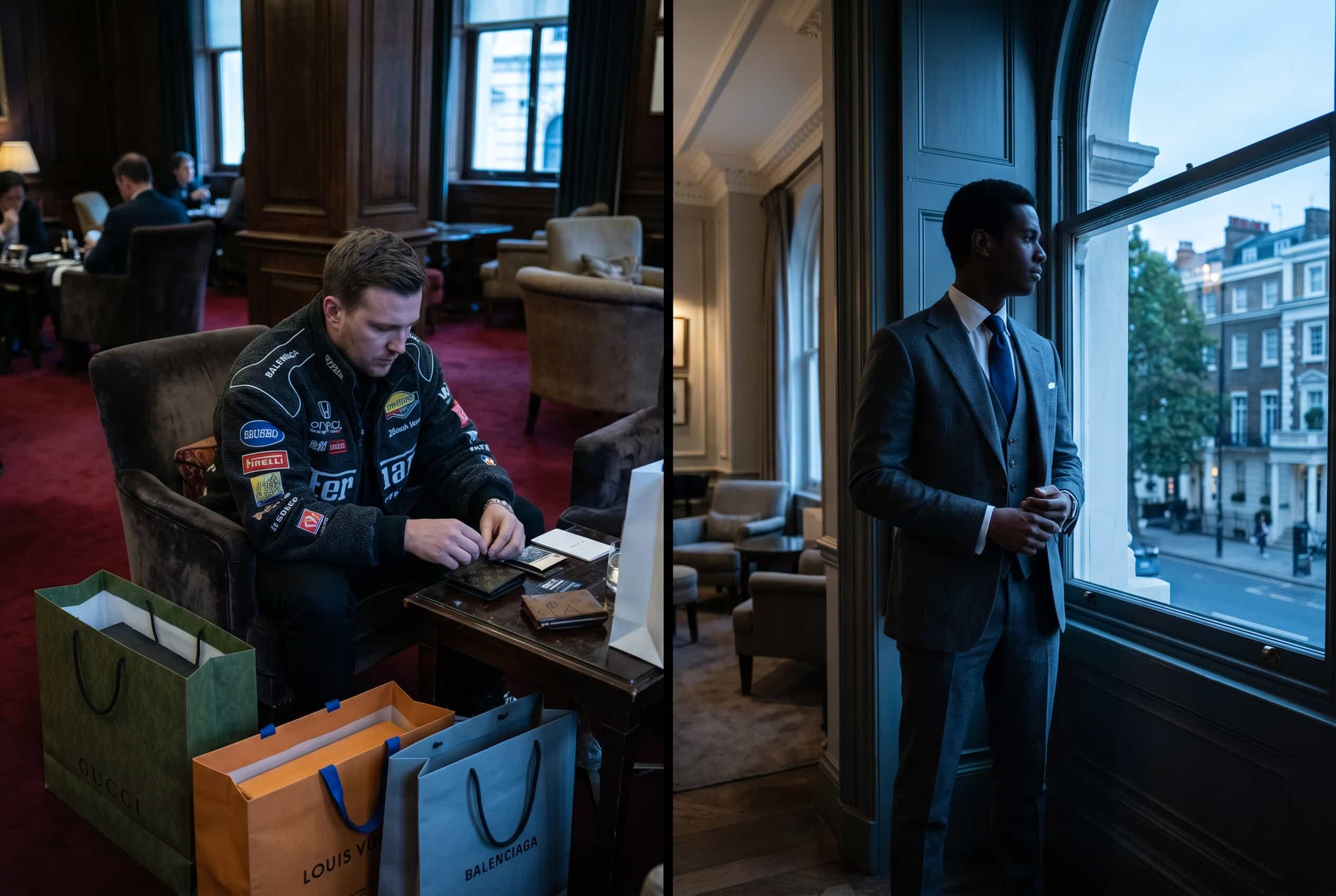
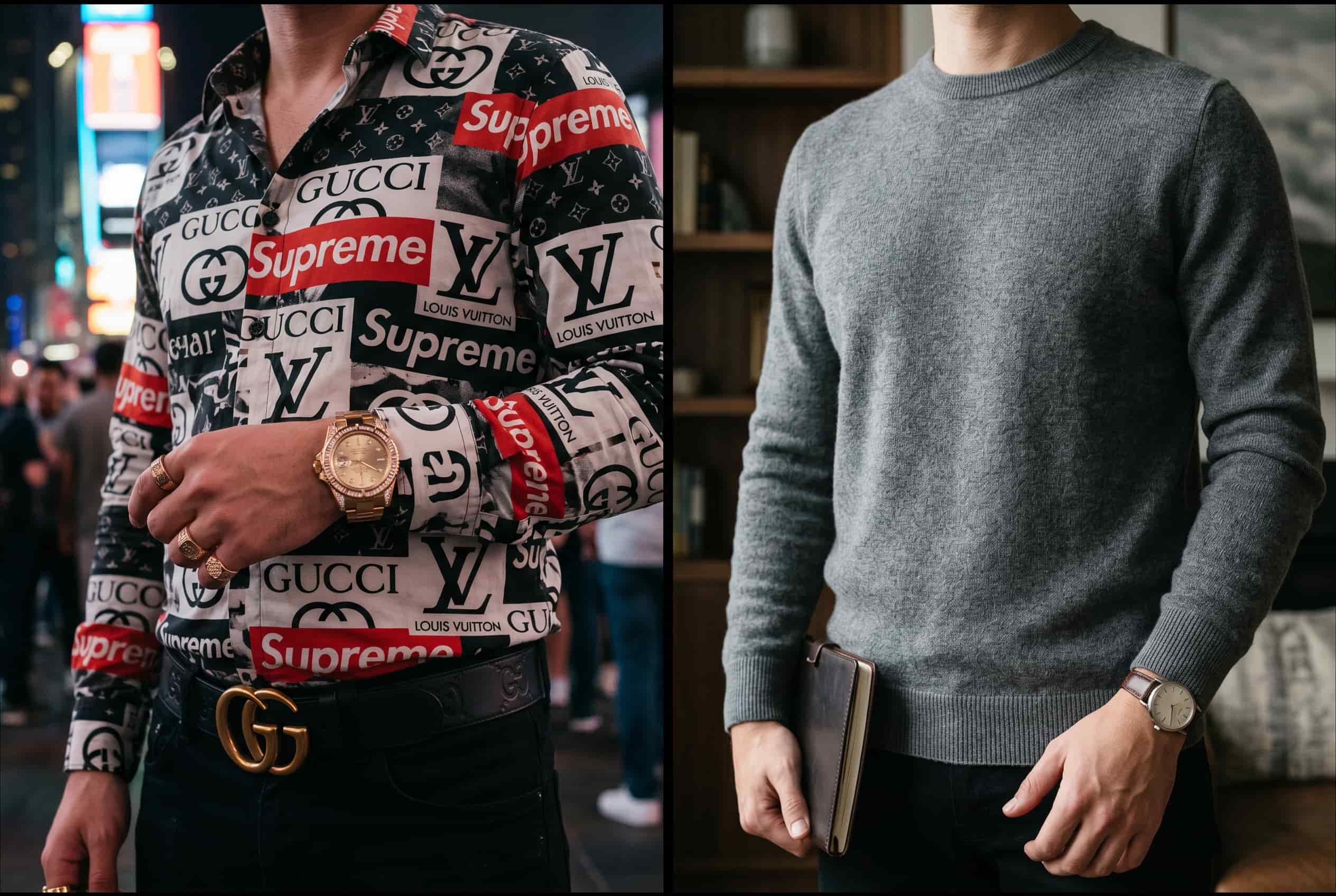
A man walks into a restaurant wearing a watch the size of a small clock, a belt buckle that spells out a designer name in bold metal, and a jacket patterned with a monogram repeated so often it becomes visual static. He expects to be noticed. He is. The room glances, assesses, and dismisses him in the time it takes to unfold a napkin. He looks rich. He does not look respected.
Across the room, another man arrives. Grey flannel trousers. A navy cashmere crewneck. A watch so thin it disappears under his cuff. No logo. No statement. He is not asking the room for anything. Yet the staff straighten their spines when he speaks. The first man spent more. The second man understands something the first one missed entirely.
The Two Currencies of Appearance
Looking rich and looking respected are not the same transaction. They operate on different currencies. Wealth is a resource. Respect is a response. You can spend money on the first. You must earn the second through a combination of restraint, proportion, and self-possession. The confusion between these two currencies is why so many men dress expensively and still look insecure.
The man who chases a “rich” look is broadcasting a single message: I have the means to acquire this. It is a message about purchasing power. It tells the viewer nothing about his judgment, his temperament, or his role in any given room. The man who earns respect through his appearance transmits something far more layered. He signals composure, awareness of context, and an internal standard that does not require external validation.
A simple test: remove every visible indicator of cost from an outfit — the brand signatures, the recognizable limited editions, the status accessories. If what remains still reads as strong, you are looking at a respected man. If it collapses into mediocrity, you were only ever looking at a receipt.
Why Conspicuous Wealth Can Lower a Man’s Standing
Visible luxury, when worn without discipline, acts as a social debt. It asks the observer to acknowledge something the wearer has not yet proven. That request is felt, often unconsciously, as a form of pressure. And people resist pressure.
In professional and social settings, the man who arrives wearing his net worth on his sleeve sets up an expectation he must then work to overcome. He has given the room a reason to be skeptical before he has given them a reason to trust him. A more restrained man enters neutral. He allows his conduct, his speech, and the quiet coherence of his silhouette to build the case for his standing. By the time anyone notices his watch, he has already been respected for ten minutes.
There is a psychological dimension here. Loud dressing is often a compensation mechanism. I have seen this on the buying floor and inside fitting rooms for years. The men who pushed hardest for the most visible branding were frequently the ones who felt least secure in their position. They dressed to fill a gap. The clothes became a prosthetic for presence, and prosthetics rarely look natural.
The Visual Architecture of a Respected Man
If respect has a silhouette, it is built on four structural pillars. None of them require a logo. All of them require discipline.
Question: What visual signals separate a respected man from a merely rich-looking one?
Signal | Rich-Looking (Often Fails) | Respected (Commands Attention) |
|---|---|---|
Silhouette | Boxed, overly tight, or fashion-forward shapes that prioritize trend over anatomy | Clean shoulder line, jacket follows natural drape, trousers hang without pulling |
Material | Shiny, heavily textured, or synthetic blends that catch light for attention | Matte wool, grain leather, brushed cotton — surfaces that absorb and soften light |
Color | Bright accents, contrast color-blocking designed to stand out | A restrained palette: charcoal, navy, dark olive, cream, black |
Accessories | Oversized watches, thick branded belts, statement sneakers | A thin dress watch, a pin-buckle belt, polished wholecut shoes — items chosen for finish, not fame |
A respected man’s clothing does not interrupt. It supports. The eye moves across his frame without catching on a loud label or an ill-proportioned detail. That visual smoothness is not boring. It is authoritative. It tells the room that this man is the message, not his tailor.
Restraint Is Not Absence. It Is Precision.
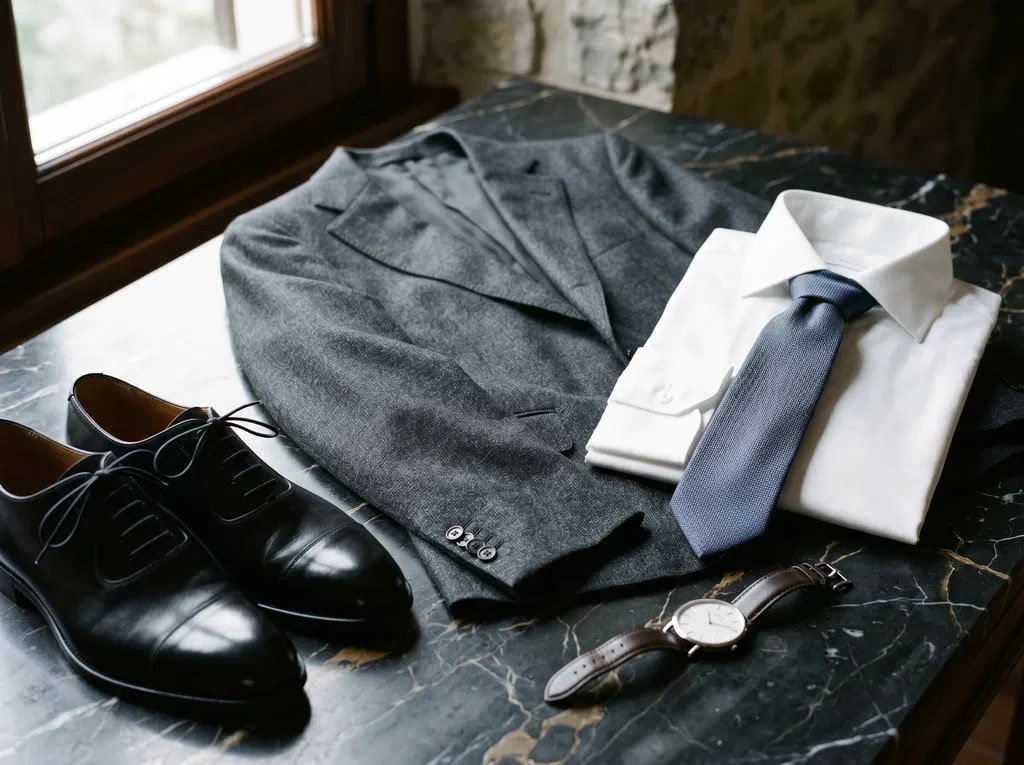
One of the most persistent misunderstandings in menswear is that restraint means dressing dull. It does not. Restraint means editing until only the necessary remains. A charcoal suit with a perfectly pitched lapel and a single visible detail — perhaps a pocket square folded with architectural sharpness — says more than a printed jacket ever could. The difference is that the statement belongs to the man, not to the garment.
I once advised a client who was about to lead a significant business negotiation. He wanted to wear a recognizable designer tie to signal success. I suggested a solid grenadine tie in deep burgundy instead. After the negotiation, he told me the other party, a notoriously difficult principal, had asked him at the end who made his suit. The suit was off-the-rack, altered by a skilled tailor. No label had won that moment. Proportion had.
A Final Calibration
Men are taught, often by marketing rather than by mentors, that status must be visible to be real. It is a profitable lie. The most formidable men I have ever dressed or observed did not wear status. They wore silence, structure, and fit. The respect they received was not applied by a label. It was built into their silhouette, piece by piece, decision by decision.
If you want to look rich, you will succeed, and some people will be impressed. If you want to look respected, you will need to strip away every signal that begs for approval and replace it with signals that assume it. That is a harder project. It is also the only one that lasts.
Luxury is not the label. It is the discipline.