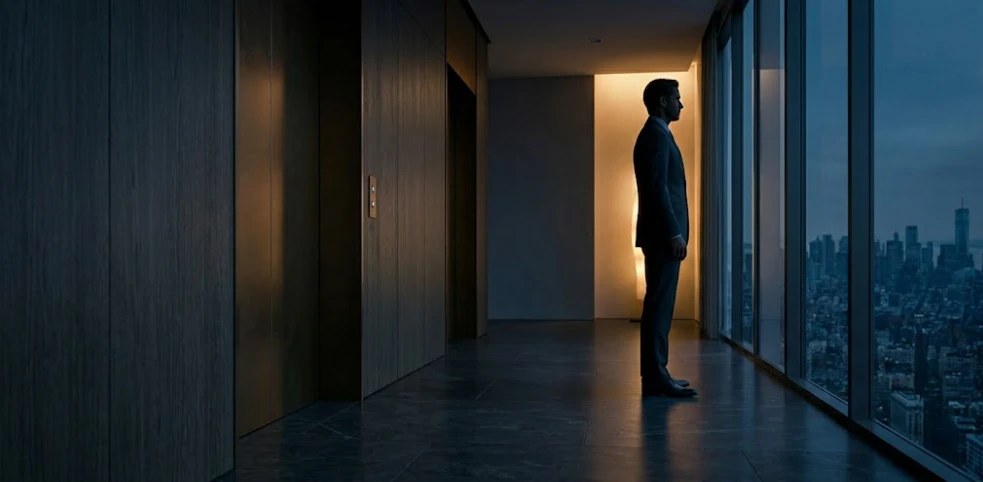
A man walks into a room wearing a jacket covered in monograms. Before he speaks, the room has already placed him. Not as powerful, but as someone who needs the room to know the name stitched across his chest. That need is the opposite of authority. I have seen this scene play out in Manhattan boardrooms, private club lounges, and client dinners more times than I can count. The result is always the same: the loudest garment in the room belongs to the most uncertain man in the room.
This is not about wealth. It is about security. When a man understands proportion, fabric, and fit, he does not need a logo to speak for him. The clothes become architecture for his presence, not a billboard for his anxiety.
The Psychology of Volume
Loud luxury is a visual plea. It asks for recognition. A quiet, disciplined wardrobe assumes recognition has already been earned. The difference is everything.
Men who rely on visible branding are outsourcing their identity to a label. They are signaling that without the monogram, the viewer might not know they are worth paying attention to. That is a brittle foundation. Real presence does not need to introduce itself twice.
I have worked with clients who walked into my consulting studio wearing head-to-toe logos and left wearing single-ply cashmere, a well-cut trouser, and a watch no one would recognize from across the table. The shift in how they were treated — by maître d’s, by colleagues, by strangers — was immediate. They stopped begging for status and started commanding it.
Signs Your Outfit Is Shouting Instead of Speaking
If you are unsure whether you are guilty of dressing for validation, ask yourself this: if you removed every visible logo, monogram, and branded buckle from your outfit, would the look still hold its weight? If the answer is no, you are not wearing style. You are wearing advertising.
Below are the most common signs of loud luxury and why they erode male presence.
Question: What are the most common signs that loud luxury is undermining a man’s image?
Sign of Loud Luxury | Why It Backfires | The Quiet Alternative |
|---|---|---|
Repeated logo patterns on bags, belts, or shirts | Reads as an unpaid brand ambassador, not a man of taste | Full-grain leather without visible hardware branding, solid shirts |
Oversized designer sneakers with exaggerated soles | Juvenile energy that clashes with adult authority | Minimal leather sneakers or clean wholecut derbies |
Large metallic brand plaques on belts | The eye goes to the label, not the silhouette | A simple pin-buckle belt in bridle leather |
Head-to-toe runway looks worn without adaptation | Signals a follower, not a leader | One statement piece balanced by quiet, foundational garments |
Watches purchased for recognition, not for movement or proportion | Conversation starter for the wrong reasons | A thin, manually wound dress watch on a leather strap |
The Quiet Alternative: Building Presence Through Restraint
There is a reason certain men can wear a grey crewneck sweater and black trousers and look more formidable than a man in a heavily branded suit. It is not magic. It is the disciplined application of a few non-negotiable principles.
First, silhouette controls perception. A clean shoulder line, a tapered trouser leg with the correct break, and a jacket that follows the natural drape of the body create a frame that reads as composed and physically capable. Logos cannot fix a broken silhouette. They only make the error louder.
Second, material precedes meaning. Before anyone processes a brand, they process texture. Dry, matte wool. Grain leather. Brushed cotton. These surfaces catch light differently. They send a primal signal of quality that the brain registers in under a second. That signal is far older and deeper than any printed monogram.
Third, color discipline separates the serious from the decorative. A palette of charcoal, navy, dark olive, cream, and black does not ask for attention. It invites respect. It tells the viewer the man wearing it has other things to do besides curate an outfit for Instagram.

Lessons From the Buying Floor
When I was buying menswear for a high-end department store, I saw the sales data behind the style. The same customers who purchased the loudest seasonal statement pieces were often the most likely to return them. They chased a feeling. When the feeling faded, so did the perceived value of the garment.
The clients who invested in fewer pieces but chose construction, mill-sourced fabric, and perfect sleeve pitch over hype never returned anything. They wore each piece for years. They looked richer with every wear. Not because the clothes became more expensive, but because the man wearing them looked more certain.
That certainty is what I now teach. A man’s wardrobe should reflect decisions, not impulses. Every garment should answer one question: does this make me look more substantial, or just more noticeable? Noticeable is cheap. Substantial is rare.
A Final Verdict
Most men do not need more clothes. They need better judgment. The pursuit of quiet luxury is not about rejecting design or craftsmanship. It is about rejecting the idea that you need a badge to be seen. You do not. If it needs to shout, it probably is not refined.
Luxury is not the label. It is the discipline.